The yin and yang of yoga practice and life
The qualities we bring to our yoga practice can help us sail through life, as long as we apply the tools and practice with diligence. Bringing the outlook we learn on our mat into our daily lives is potent and life-affirming.
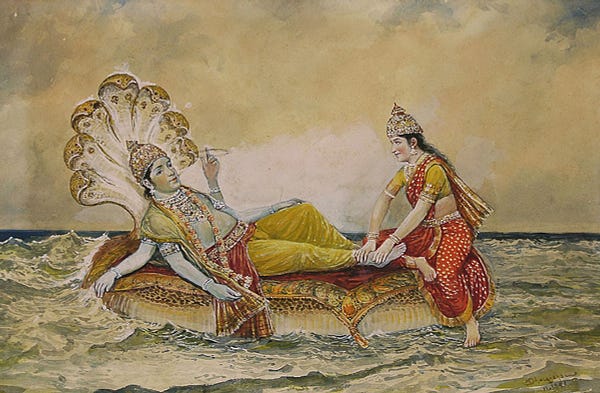
Picture Ananta-Shesha, thousand-headed serpent-king, floating languidly on an ocean of milk, effortlessly balancing the earth on his heads while cradling Lord Viṣṇu in his lap.
The weight of the world has no effect on this mythical ruler of the serpent-race. Not even the movement of his breath disturbs his Lord, as Viṣṇu lazily reclines in cushioned comfort, his consort Lakshmi massaging his feet. The planet balanced on the serpent-king’s heads never even quivers.
That image from Hindu mythology is the perfect example of sthira and sukha, steadiness and ease, the essential qualities of yoga asana practice as prescribed by ancient yogic sage Patanjali.
थिरसुखमासनम् ॥४६॥ sthira-sukham-āsanam ||46||
One’s connection to the earth (asana) is steady (sthira) and joyful (sukham).

Sthira means “to be stable or firm, conscious, present and alert,” while sukham means “to be soft, at ease, relaxed, tranquil and comfortable.” To embody sthira, our poses must be strong, directed, energetic. To summon sukha, we need to remain relaxed, serene, and blissful. Together these are the yin and the yang of āsana.
If we consciously practice with steadiness and ease, we can learn attitudes and approaches which can serve us well in our everyday life and our interactions with others.
As yoga teacher Gary Krafstow notes in _Yoga for Wellness, _ Ananta symbolises the ability to take full responsibility for being a healthy human being in the context of our personal, social and physical environment, while at the same time being relaxed and at peace in our body, mind, and heart.
Organic transformation
To some extent, acquiring sthira and sukha is an organic process; with both qualities slowly becoming second-nature in our practice and life. That is, if we are diligent in applying the tools of wisdom, breath, focus and presence.
Wisely using breath and presence as our tools, we learn to saturate our yoga practice with sureness and lightness. Doing so sets us well on the way to transforming our daily lives, our outlook and our very ways of interacting with the world around us.
Like Ananta, we try to keep our bodies so soft and gentle they could serve as a couch for a god, (sukha) while remaining firm and steady enough (sthira) to support the whole earth. At the same time, we exert progressively less effort in developing both.
To practice with sthira and sukha is to achieve vinyāsa krama, a fundamental principle of yoga. Since krama is the step, nyāsa means to place, and the prefix vi- translates as in a special way, viṅyāsa krama tells us that we must do more than simply take step; that step must be performed correctly and set us on the right path.

Viṅyāsa krama can help us move through the world without effort, comfortable in our bodies and confident in our right to make an impact.
“Viṅyāsa krama … describes a correctly organized course of yoga practice. It is a fundamental concept in yoga having to do with constructing a gradual and intelligent course for our practice, and is important to employ irrespective of whether we are dealing with āsana practice, prāṇāyāma, or some other aspect of yoga”, wrote influential yoga master T. K. V. Desikachar in _The Heart of Yoga: Developing a Personal Practice_.
“It requires ensuring we are fully present in every moment, and infusing our practice with sensitivity and intelligence. In time, vinyāsa krama can become a very part of our essential nature, influencing every aspect of our lives.
“…A famous yogi of old named Vamana is reputed to have said that without viṅyāsa the āsanas of yoga cannot be mastered. The concept of viṅyāsa krama is useful as a guide for carrying out not only our yoga practice but also all the tasks of our everyday life.”
By creating balance and harmony, vinyāsa krama brings physical, mental and emotional benefits.
On a physical level, mindful and intelligent practice balances our neurological and hormonal activity, strengthens our cardiovascular and respiratory function, improves digestion and elimination and strengthens our body’s ability to resist and heal disease.
Emotionally, proper practice brings greater self-confidence, helps us feel tolerance and compassion for others, makes us more resilient.
Intellectually, it helps us achieve more considered and balanced attitudes. and helps us approach even the stickiest problems calmly and rationally.
It also empowers us to believe we have a right to be here on this planet and to stand up and positively influence our world.
Gradual, sensitive and intelligent
In search of vinyāsa, in my own practice I begin even before I take tadasana (mountain pose), by resolving to engage sthira-sukham asanam in everything I do. I like to sit before my altar, setting my intention then bowing my head with reverence to honour myself, my practice and my intention for the day.
Then each time I step on to my mat I start from where I am at that very moment, fully acknowledging and honouring my current somatic condition and being prepared to work within my current limits. I try to ensure I’m always approaching practice with sensitivity and awareness, always prepared to take an incremental approach to improvements, ever-honouring my current limitations.
Honouring this fundamental concept, I strive to practice gradually and intelligently, taking the steps that will lead me towards my goal. Then I take time, after each sequence, asana or pranayama, to notice and appreciate any changes I might have achieved.
It’s amazing how much this approach now influences my life. It’s what helps me watch what I speak, makes me more sensitive to others, helps me listen to the inner voice always offering wisdom and guidance.
It let’s me speak my truth in ways a younger me would have found terrifying or impossible. It helps me love the world in the face of adversity.
Intelligence and Sensitivity
Vinyāsa asks that we remain very gentle, ever-sensitive to the signals our body is sending us, even when we are practising with strength and vigour.
And it also asks that we balance our habitual inclinations towards our practice with an intelligent and sensitive understanding of our current needs.
If we always tend to graduate towards slow and gentle styles, such as restorative or Yin yoga, it requires us to ask ourselves whether a more vigorous Vinyasa flow practice might not better serve us today. If our habit is to push ourselves on the mat, practicing vigorously every day, it asks us to inquire whether a more gentle practice, or even a rest day, might better serve us this morning. We can learn such balance from the Tao of Healing, which advises:
To build up, dismantle first,
To expand, contract first,
To attain clarity, allow confusion,
To become civilized, first live in the wild,
The balance of all things is in their opposites,
The truth points in both directions,
Thus, the clenched fist holds weakness within;
And the open hand offers the hidden power of the sun.
Practicing what will best serve us today, rather than what might best please us, is the essence of finding balance in our practice and then in the decisions we take about our lives. Taking the path of most resistance allows us to grow. Balance is key. Yin and Yang.
We also must fully inhabit our bodies, practising with presence and awareness always. In this way, we learn to stay fully awake to our lives.
Bernard Bouanchaud, in The Essence of Yoga: Reflections on the Yoga Sutras of Patanjali, notes that the verbal root _as_ conveys the sense of “being present in one’s body — inhabiting, existing, living in it.” The literal translation of asana is “to take one’s seat,” which can be interpreted to mean being just here, just now, in the present moment, thus embodying the meditation practices found in earlier writings on yoga in the Vedas and Upanishads.
“In practicing asana, we create a ritual of entering and holding the posture without interruption for a period of time, being fully present with all the details, sensations, and experiences that occur in the body/mind,” writes Deva Parnell in her article The Sadhana of Teaching: Balancing Polarities of Tension and Relaxation.
“We compliment the qualities of engagement with letting go. We find a balance between tension and relaxation, a balance between effort and ease that feels delicious and challenging at the same time. Sthira and sukha form a state of equilibrium (satva) that is without agitation (rajas) or inertia (tamas).”
Parnell notes that our personality type leads us to. emphasise one or another of these qualities in any given moment.
“Over-achievers need reminders to relax and be enjoy the experience. Those who tend to be lethargic or half-hearted need encouragement to work at their edge. Those who lack focus need reminders to stay present. Students with limitations need support in creating modifications and working at a gentle level that’s still challenging.”
Vinyasa means being present at every moment, alive to the stretch in our muscles; the sensations on our skin and in the nadis running through our body; the silkiness or roughness of our breath; our thoughts; and our emotions as we move from pose to pose. It asks that we transition from sequence to sequence and pose to pose gracefully and mindfully; and that when we when we sink into savasana we stay with this awareness, rather than allowing our thoughts to drift.
We can help maintain awareness by being constantly alert to the natural wave-like movement of the spine which occurs naturally when we are moving and breathing correctly. These fluid movements bring life and vitality to the spine while encouraging the free flow of cerebrospinal fluid and other bodily secretions, while staying attuned to the motion can help us enhance the effects.
Steadiness of Mind
Steadiness of mind is the constant yogic practice of non-attachment. We are all too tolerant of mind wandering or giving permission to fear-dominated thoughts that lead to an unsteady, vacillating mind.
“Steadiness of mind is the practice of observing your wrong-mind’s unsteadiness without judgment, which automatically brings you back to love’s right-minded steadiness,”writes Jeff Bailey in The Yoga Mind: The Yoga Sutras According to a Course in Miracles.
“Do not confuse steadiness with rigidity. This is a gentle practice of self-vigilance that incorporates a Yogic quality of flexibility and openness. Steadiness of mind is not a demand that anything in the world of form be changed or different. Rather, steadiness of mind is an ongoing inner recognition of an inner seed that has already been planted. It is a seed of heightened awareness that sees past the ego’s world of attachment and separation and kindly repurposes it to join in mind. This repurposing is what gives meaning to a lifetime. Purpose is always given from within; it is not found by looking outside of yourself.
The Wind Through the Instrument
As Patanjali tells us, our breath is the best tool we have to help us remain present and aware in an asana. It is through the breath that we can truly link the mind to the body, not at an imaginary level but as an actual and tangible experience.
As the old saying goes: “Where your attention goes, prana flows.” Consciously sending breath into areas of stuck prana, or chi, can help release the unconscious tension we hold and help us move our poses to the next level.
“Think of your body as a musical instrument, a wind instrument,” suggests Eric Schiffman in Yoga: The Spirit and Practice of Moving Into Stillness. ‘Your breath, accordingly, is the wind through the instrument. As such, it is the single most important aspect of yoga technique. Traditionally considered the primary carrier of prana life force — your breathing originates deep inside you, radiates outward and then inward, providing a gentle and steady rhythm for movement, stretch and release.”
When we coordinate our movements with our breath we can turn each practice session into a fluid and creative meditation. As we gain skill in this, we can experience breath and movement as one, inseparably entwined.
Push and Yield
Every yoga posture involves a “push” and a “yield,” and by consciously working with both we can go deeper into our poses without risk of injury and without disturbing our mind.
Pushing is an active force that moves the body further and deeper into the posture as you tenderly explore areas of tightness. Yielding is a passive force; as you tune into the moment-to-moment feedback from your body, you mindfully surrender resistance, yet respecting your limitations. Letting go of resistance is what allows us to be active without doing violence to our body.
When we push and yield simultaneously, our yoga becomes a kind of dance, a glorious balancing act between “doing” and “not-doing,” a celebration of mastery and a lesson in easy living.
The breath is the vehicle, push and yield, control and surrender, doing and not-doing, and it represents a unique link between these two forces.
“Skill in yoga involves orchestrating these two forces with the breath,”Schiffman instructs. “This means that sometimes you will push with the breath into your tight areas, or challenge your endurance, or deliberately increase your sense of “fire” and energy by consciously breathing with more vigor and intensity. At other times you will ride the breath and stay soft, mellow, and be in a pose with minimal effort. With your breathing you can creatively orchestrate the tone of your practice.”
Taking it Off Our Mats
Once we have mastered an attitude of vinyāsa krama, we are in an excellent place to creatively orchestra the tone of our lives.
Moment by moment, we can be vigilant for any thoughts of fear or attachment, no matter how slight, and correct them through self forgiveness.
Moment by moment, whenever we can, we can remain attuned to our breath. We take twenty-one thousand breaths every day. If, as frequently as we can we become vividly aware of the vibration of the prana, the feel of the breath as it moves through our body, we can not only improve our daily lives, but put ourselves on the path to enlightenment.
The Zen masters say, “If you can maintain the awakening breath with the constancy that a slate tile dropped at the surface of the ocean descends towards the depths of the ocean without a single break, you’ll be completely enlightened in seven days.”
Yin and Yang. Balance in all things. The perfect equation for a well-ordered and joyful life. Adopting an attitude of viṅyāsa krama can make as as steady and stable as Ananta-Shesha, if we let it.


 English